A clean Case
Bill pulls up at the laydown yard for smoko at 11, the air filter warning light had come on 2 hours before. After smoko he pulls the cover off and gets the filter out. It’s visibly clogged and obviously restricting airflow to the engine – driving a grader does that. It can’t go back in like that, but what does he do?
What do air filters do?
To answer this, it’s important that we understand what filters are doing. Air filters (or air cleaners) are designed to remove impurities from the air that engines need for combustion. They are made of layers of woven fibrous mesh, pleated to increase their surface area, and typically filter broad airborne impurities larger than 2 microns from the engine air.
Their purpose is clear – to enable the engine to access cleaner air to burn. Why? Because this air is sucked directly into the combustion chamber and mixed with an atomized mist of fuel before being compressed by the pistons. Silica-based dust particles can combine with engine oils or fuels to create something like an abrasive lapping paste. Sensitive parts (the airflow sensor and turbo), tight tolerances, high heat, and moving parts don’t enjoy airborne fines – and as little as 1 teaspoon of dust can severely damage or destroy an engine.
To clean or not to clean?
In treatment of clogged filters, there are 2 main camps, and a middle path.
· Mechanics and service technicians who are engaged to perform scheduled maintenance or repairs on a piece of machinery will always replace with new filters as a failsafe and to limit potential liability down the track. This is expected and necessary, where cleaning an old filter will reflect negatively on the workmanship of the mechanic.
· Equipment owners and daily operators will often clean their filters – knowing that they’ll never get a 100% as-new filter by cleaning it – but extending the life of the filter by giving it a once-over and keeping it clean until it’s time for scheduled replacement.
· There is a 3rd category – mining and large fleet (freight/transport/contractors) who go through a large quantity of filters, will often stockpile dirty filters and get them taken away to be professionally cleaned. This sits between the other 2 schools of thought and gets the best of both worlds – middle range cost-effectiveness, limited liability by guaranteed service and proper post-cleaning inspection, at the expense of minor inconvenience (depending on the contractor).
Pros and Cons
|
Buying new every time |
In-house cleaning as-needed |
Professional cleaning |
|
Pro |
Pro |
Pro |
|
Always good filter, guaranteed |
Cleaned when needed |
Mid-range economics - cheaper than replacing, more expensive than in-house cleaning |
|
Effective cleaning |
Usually guaranteed service, with inspection after cleaning |
|
|
Cost effective |
||
|
Con |
Con |
Con |
|
Cost per filter |
Original outlay of equipment |
Costly per filter |
|
Landfill and waste – elements are not viable to recycle. |
Requires access to compressed air |
Effectiveness depends on equipment used |
|
Can cause damage to filters |
Some time delay - collection/drop off, waiting for chemical to dry |
|
|
Can affect engine or OEM warranties |
Another account/subscription to manage |
|
|
Risk of dust re-ingress into inside/clean side of filter |
Risk of damage to filters - possible softening of filter fibres |
What are the risks with cleaning filters?
In short, it’s the potential for filter element damage.
In what ways can cleaning filters damage them?
· For mechanical cleaning, where an operator is physically shaking the dust off a filter by kicking it or banging it against a tyre – shock, physical damage, rips and tears to the filter medium, crushing or deformation of the mesh liner.
· With chemical or ultrasonic (professional) cleaning – weakening of the fibres and sheets from soaking them, although this is largely mitigated with a post-clean inspection that most of these providers do.
· For pneumatic cleaning, depending on the method or tool used, high pressure blow-through of the delicate filter papers, and re-ingress of dust into the filter.
o Some methods of pneumatic cleaning also risk mechanical damage especially with the “spinning prongs” style cleaners.
With these risks in mind, what is the advantage of a clean filter?
A clean, or a new, filter allows more air into the engine for combustion so the engine can perform at its optimum rate. A clogged or dirty filter restricts airflow, making the engine work harder just to be able to breathe. This makes the engine run rich, burning more diesel or petrol for the power created – an important consideration with today’s fuel prices – and leads to higher temperatures and accelerated wear on engine components. At a high level of contamination, where blockage is severe, an engine can create sufficient vacuum to collapse the filter, which will result in a catastrophic level of dust ingress into the intake manifold and almost certain engine damage.
Cleaning the filter on a schedule, or depending on workload and environmental conditions, allows the engine to breathe clean air freely and operate effectively, without the expense of a new filter element every time the indicator light or gauge shows red.
Other considerations
· Dust suppression
o Cleaning filter elements with pneumatic or mechanical means results in a dusty local environment, which carries risk of inhalation for the operator and risk of dust ingress to the engine if atmospheric dust settles in the open air cleaner canister. Always close the air cleaner canister when cleaning the element, and always wear appropriate PPE – including a P2 respirator and eye protection.
· Machinery warranty
o Many OEMs and engine manufacturers have a note about clean air filters in their manuals, and some even limit their warranty based on having new filters rather than cleaned filters.
· Post cleaning inspection
o After cleaning in any method, always perform a post-cleaning inspection of the filter. A visual inspection of the outside of the pleats will show the most obvious signs, but holding the filter up to sunlight and looking inside it while rotating it gives a clearer indication of any damage. If unsure, replace the filter.
· Secondary filters
o Most filter canisters are built to allow a secondary filter to be installed – this serves 3 purposes;
§ It provides a backup, if the primary/main filter has been damaged, the secondary filter will catch the dust before it can do any damage (be aware that the secondary filter is not designed for the main filter’s job, and therefore will clog much faster),
§ It’s an indicator of primary filter failure – if the primary filter has been removed and dust is observed on the secondary filter, the primary is damaged,
§ And while the primary is being cleaned, the secondary filter prevents dust getting into the intake ducting.
Back to the story
Bill sees the markings on the top cap of his filter element; its original installation date was 2 months before, and he knows it’s been blown out almost daily since then. The media is locked solid with dust, but there’s a bit of staining coming through to the inside of the filter: time for a replacement. He takes it to the project foreman who takes a new filter off the shelf, makes a note to re-order, writes the date on the new one, and disposes of the old one. 10 minutes, Bill’s back in business.
Where do we come in?
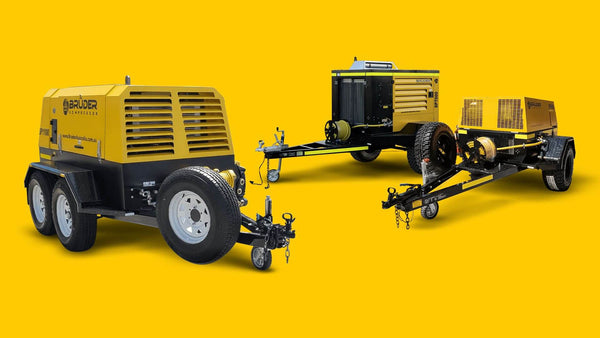
Brüder Australia are in the portable compressed air market. In early days, we were leaning towards camp 1 – always replace for new filters. As we spoke to people from different industries – farmers, contractors, earthmovers, council workers, mining companies – we came to realise that what’s written in the book isn’t always an economical proposition in the field. Not many operators replace a filter every 4-8 running hours on a dusty paddock, or every shift in a quarry.
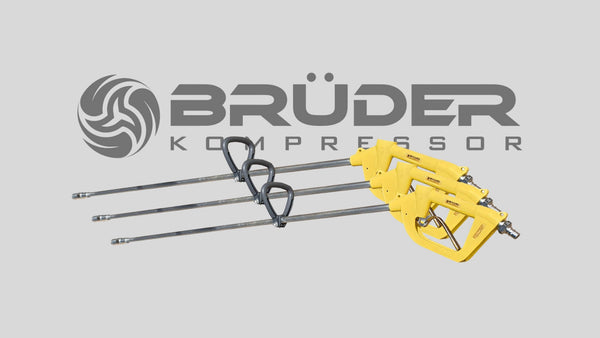
We were getting asked for a filter cleaner, so we made one.
But we didn’t copy or resell an existing design. We noted the shortcomings of other products on the market, and the feedback from people who have made something that works, and then we patented a design that ticks all the boxes:
- · A spinning head, but without protrusions that can catch filter pleats and damage them;
- · A slight (but deliberate) unbalance in the spinning head to introduce vibration at ~60Hz to help loosen contaminants;
- · Nozzles that have a dead-end pressure of less than 30PSI – for both operator safety, and prevention of damage to the filter;
- · A flow-control knob that allows fine-tuning of airflow separate to the trigger;
- · And a heavy weighted cone, to seal the top of the filter while it’s being blown from the inside out, preventing dust ingress.
There will always be people that clean their filters; we feel they should clean them in the safest way possible. It’s not a new filter, but it’s the next best thing.
Google “Brüder Filter Cleaner” to find a dealer near you.