and what makes a compressor up to the task
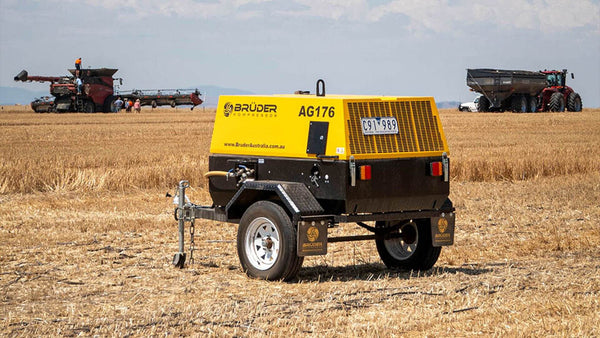
Every harvester operator knows that daily blowdown of your combine harvester (or header) isn’t just smart – it’s essential. Whether you’re trying to reduce fire risk, maintain performance, or meet operational best practices, compressed air is the only tool up to the job.
But if you’ve ever tried doing a full blowdown using an underpowered or poorly matched air compressor, you’ll know just how physically demanding the task is – on both the machine and the operator.
So why is header blowdown so tough on compressors? And what makes some compressors clearly better for this job?
Let’s unpack it.
What is header blowdown — and why so much air?
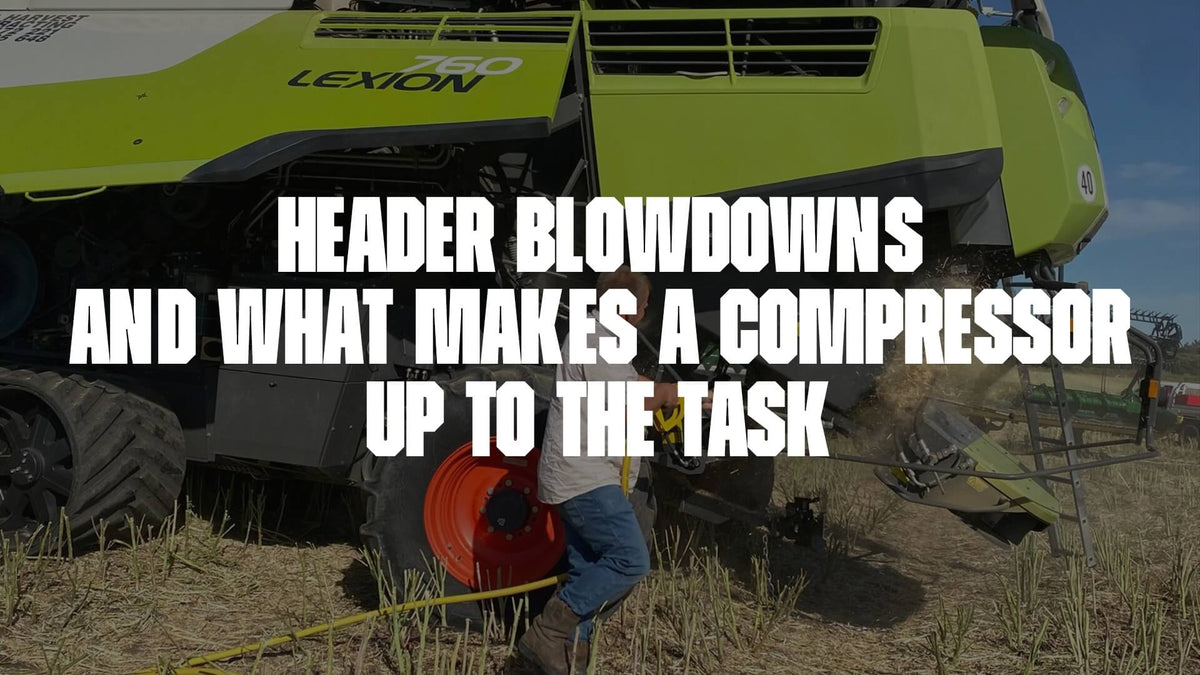
Header blowdown refers to the process of clearing out accumulated crop dust, seeds, and chaff from all the critical areas of a combine harvester – especially around the front, engine bay, radiator, belts, pulleys, and manifolds.
In dry harvest conditions, static charge and heat combine with airborne residue to create a perfect storm for fires and mechanical wear.
That’s why contractors and farmers across Australia now treat blowdown as a daily ritual – often done multiple times per day in tough conditions. And it’s why compressed air demands have increased dramatically.
Modern headers are bigger, faster, and more enclosed than ever. The result? More places for buildup, and more air needed to shift it.
Why is the task so tough on air compressors?
Here’s the core challenge: there’s no air storage tank to help out.
Unlike workshop-style or piston compressors that use large air tanks to store and regulate pressure, a diesel-powered, rotary screw compressor like ours runs full-time, sending every litre of air straight from the screw to the outlet.
There’s:
- No buffer
- No delay
- No cushion for backpressure
- No recovery time once the air’s used
It’s a “live” system — meaning the compressor is expected to keep up with real-time demand, minute after minute, operator after operator.
That’s what makes header blowdown such a punishing test. It’s sustained, high-volume output, with no relief. If the unit can’t keep up, pressure drops and overheating over time a likely result.
Flow beats pressure – every time
There’s a common misconception that more PSI equals better cleaning. While true in part, it’s not pressure that clears the debris – it’s volume.
Here’s why:
- Pressure (PSI) is how fast the air is moving
- Flow (CFM) is how much air is available
If you have high pressure but only a trickle of air, the nozzle gives a sharp blast but can’t maintain momentum. For header blowdown, what you need is a constant flood of air, not a pulse.
That’s why our focus – and yours – should be on:
- CFM output at working pressure (typically 100–125 PSI)
- Sustained delivery under load, not just rated figures
A good blowdown compressor doesn’t just build pressure – it delivers bulk airflow continuously, because there’s no tank to lean on when the job gets tough.
What’s different about a compressor designed for blowdown?
Many popular compressors on the market are built for general trade or industrial use. They’re great for running rattle guns or hammers – but when it comes to 20+ minutes of wide-open airflow through a blowdown gun, they overheat, cut out, or stall under load. Worse, they progressively leak oil into the airstream because the air/oil separator can’t keep up – leading to low compressor oil with expensive consequences.
A compressor built for agricultural blowdown needs to be:
- Engineered for continuous flow – Rotary screw compressors are the only viable choice here – but not all are equal. A air-end and motor combo properly matched to the demand is vital to avoid lag or pressure collapse.
-
Physically rugged – It needs to be:
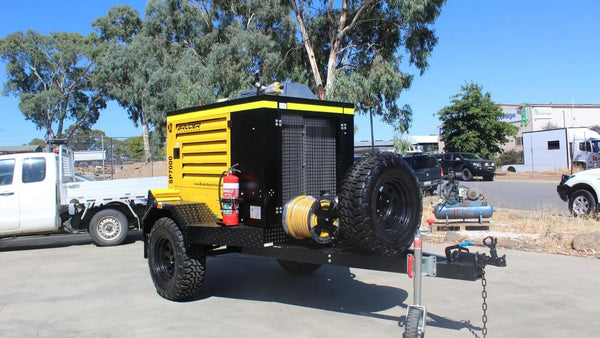
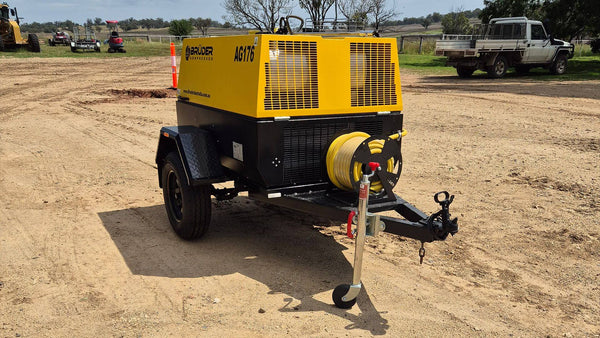
- Trailer-mounted with real suspension
- Built to survive off-road towing
- Dust-sealed and heat-tolerant
- Simple and fool-resistant – Harvest isn’t the place for fragile touchscreens or temperamental electronics. Controls should be straightforward and reliable, especially when operated by multiple users on rotation.
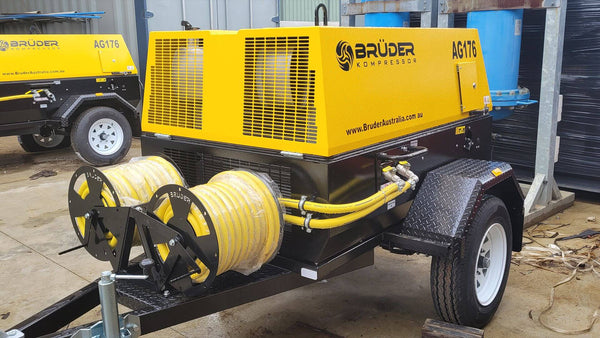
- Dual-operator capable – More and more operators are doubling up during blowdown. A compressor that can run two blow guns at once without choking airflow is a major productivity win.
- Developed for the environment – The harvest blowdown conditions are a hot, dusty environment that sees high-demand use for sometimes long periods in full sun. Engineering for the conditions requires smart design to make the best use of ambient air through the machine, to keep it running at full power in the hot summer months.
What about plumbing and hoses?
Even the best compressor can be crippled by poor plumbing. We often see:
- 3/8” hoses that throttle airflow
- Undersized nozzles
- Long runs of cheap hose with internal restrictions
- Quick-connect couplers that leak or choke
Recommended setup:
- ¾” or 1” hose (minimum) for full-flow delivery
- Short, direct runs where possible
- High-flow fittings and blowdown guns rated for 100+ CFM
- Dual outlets, if using multiple operators
If you’re investing in a high-output compressor, don’t shortchange it with poor downstream gear.
A quick note on insurance
We’ll cover this fully in a separate post, but it’s worth mentioning that insurance providers are increasingly factoring in fire prevention practices. Regular header blowdown with compressed air is fast becoming a requirement – and sometimes a way to reduce premiums.
Stopping a fire before it starts is cheaper than fighting one after the fact.
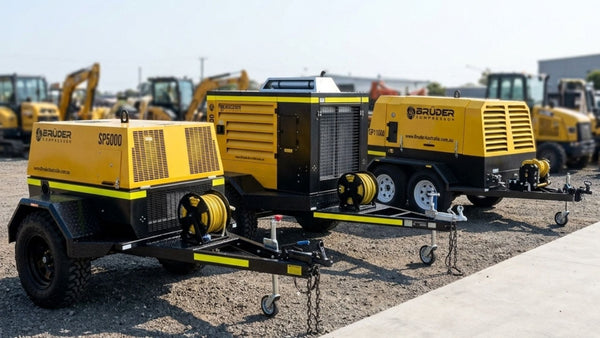
Why Bruder compressors handle the job so well
We designed our range specifically for tasks like header blowdown – not just generic compressed air use.
That means:
- Rotary screw air-end matched to real CFM output
- No storage tank — just straight-line, full-duty airflow
- Tough Australian certified pressure vessel (our air/oil separator)
- Heavy-duty trailer setups for paddock use
- Simple, intuitive controls
- Dealer support across Australia, with common parts for easy access
- Designed for shared, high-duty use in ag and hire environments
And most importantly – these aren’t stripped-down industrial units or modified workshop models. They’re built from the ground up for the field.
In summary: Know what you’re buying
Header blowdown is one of the most demanding air tasks in Australian agriculture. It requires:
- High continuous flow
- No reliance on air storage
- Mechanical reliability under extreme use
- User-friendly controls and rugged build quality
If your compressor isn’t designed for this job, it will struggle – and it won’t last.
But if you’re using a machine designed for the task – with the right plumbing and nozzle setup – blowdown becomes faster, safer, and far more effective.
Want to learn more about Bruder’s portable compressors?
Need help choosing the right unit? Talk to us — we’ll give you straight answers, not a sales pitch.